London Visitor Levy And VAT On Hotel Stays: What You Actually Pay
Two taxes shape the price of a London stay today and tomorrow: VAT, which is already inside the rate you pay, and an Overnight Visitor Levy, which exists only as a government proposal. This guide separates what is in force from what is planned, using only verified government wording, and shows what each one means for a £14 dorm bed or a £49 hotel room.
Short answer
No tourist tax is charged in London yet. The government has said mayors will get the power to introduce an Overnight Visitor Levy, charged as a percentage of the accommodation cost, with no rate or start date announced. VAT is already charged at 20% on hotel and holiday accommodation, and for stays over 28 days only the facilities element is taxed from day 29.
Is There A Tourist Tax In London Right Now?
No. No visitor levy is charged in London yet. The government has said mayors will be handed the power to introduce an Overnight Visitor Levy, that a Bill will follow, and that the levy will be charged as a percentage of the cost of accommodation rather than a flat fee. No rate, start date or cap has been announced, so nothing is added to your hotel bill today for a city tax.
That is the whole verified answer, and it is worth being precise about it because a lot of secondhand advice gets it wrong. Travellers coming from Paris, Amsterdam, Rome or Barcelona are used to a per-night city tax settling onto the bill at checkout, and they reasonably assume London works the same way. It does not. A search for the phrase london tourist tax turns up plenty of speculation, some of it quoting figures the government pages do not contain, so this guide sticks to the official wording on the government's announcement on the Overnight Visitor Levy.
The announcement, made by the ministry responsible for housing, communities and local government, sets out three things. First, mayors and local leaders "will be handed the power to introduce an Overnight Visitor Levy", which is a fee on overnight stays. Second, the government says it "will protect budget holidays by requiring the levy to be charged as a percentage of the cost of accommodation, rather than as a flat fee", specifically to shield cheaper stays from a disproportionate charge. Third, a Bill "will be introduced in due course", and the government expects mayors to set out spending plans by early 2028.
The Mayor of London, Sadiq Khan, is quoted in the same release welcoming the power: "I strongly welcome the Government giving London the power to introduce an Overnight Visitor Levy. This needs to happen sooner rather than later." So the direction of travel is clear, the mechanism is decided in outline, and the numbers are not. Anything you read quoting a specific percentage for London is not in the official text.
For a budget traveller the current position is simple and slightly unusual among big European capitals: the price on the listing is the price of the stay, subject only to VAT rules, which we come to below. A dorm bed at Smart Camden Inn Hostel in Camden sampled from £14 per bed per night, and a private room at the Dolphin Hotel near Paddington sampled from £49 per night, carry no city surcharge of any kind today.
What The Proposed Overnight Visitor Levy Would Actually Be
The levy would be a percentage added to the cost of the accommodation, not a flat nightly fee, and only once Parliament passes a Bill and the Mayor decides to use the power. Neither has happened, so there is no rate, no cap, no start date and no exemption list in force. The only confirmed design detail is the percentage-not-flat-fee rule, chosen deliberately to keep cheap stays cheap.
The distinction between a flat fee and a percentage matters more for budget travellers than for anyone else, and the government said as much. A flat fee, the model used in many European cities, charges the same amount per person per night whether the room is cheap or expensive. A flat charge on top of a £49 room is a much bigger share of that room; on a £117 double it is proportionally far less. A percentage levy scales instead, so the cheaper the bed, the smaller the charge in absolute terms.
Put that in plain words with the roster's own numbers, without inventing a rate. Whatever percentage is eventually chosen, it would take a smaller absolute amount from a £14 dorm bed at a hostel in Camden than from a £117 double room at a budget hotel in Waterloo, because the charge is a slice of the price rather than a fixed toll. Two travellers paying six times different sampled rates would pay six times different levy amounts in exact proportion. That is the entire protection the government claims for budget holidays, and it is the one design feature confirmed in the official text.
| Question | In force today | Proposed |
|---|---|---|
| Visitor levy on London stays | No, not charged | Yes, once a Bill passes and the Mayor uses the power |
| How the charge is calculated | Not applicable | A percentage of the cost of accommodation, not a flat fee |
| Rate | Not applicable | Not stated |
| Start date | Not applicable | Not stated; Bill "in due course", spending plans expected by early 2028 |
| Who decides | Not applicable | The Mayor, under powers from government |
| VAT on the stay | 20% standard rate | Unchanged by the levy proposal |
The table above is the honest summary of everything official. A word of caution about the gap between "power granted" and "levy charged": even after a Bill passes, the Mayor would still have to decide to use the power, set a rate, and give the industry time to implement it. Travellers booking stays in the near term are booking in the no-levy period, whatever headlines suggest.
The trio above spans the price range the percentage rule is designed to protect: a £49 hotel room in Paddington, a £65 room in Stratford and a £14 dorm bed in Camden, all sampled lows from the roster. When a levy eventually lands, the absolute charge on each would rise with its price, and the dorm bed would attract the smallest amount of the three.
How VAT Works On A London Hotel Stay
VAT on hotel and holiday accommodation in the UK is charged at the 20% standard rate, and it applies now, not in the future. It is a tax on the accommodation itself, folded into the price the property charges, so whether the figure on a listing already includes VAT is shown on the listing itself. There is no extra VAT to pay at the desk on top of a quoted room rate.
This is the tax that actually touches your booking today, and it is the one people misunderstand in the opposite direction from the levy. Because UK advertised prices for consumers generally include VAT, a rate shown on a live listing is usually the rate you pay, VAT and all, but whether a specific price includes VAT is a question the listing itself answers, and this guide does not assert it for any property. The underlying rule is on the government's VAT rates page, which lists the standard rate at 20 percent.
The temporary reduced rate that once gave hospitality a discount is gone. The government's hotels and holiday accommodation notice records that the temporary reduced rate which applied to tourism and hospitality ended on 31 March 2022, and that from 1 April 2022 the normal VAT rules apply at the standard rate. So every night on every stay covered in this guide's roster, from a shared dorm to a two-bedroom apartment, sits inside the 20 percent standard-rate regime.
What does that mean for a budget rate in practice? It means the tax is already inside the sampled prices, not added at checkout. When the roster shows the Dolphin Hotel from £49 per night, or the Epsilon Hotel in Stratford from £65 per night, those are accommodation prices in a 20 percent VAT country, not pre-tax prices awaiting a fifth on top. Compare that with destinations where tax is added at the desk and the sticker price flatters the stay, and the London habit of quoting tax-inclusive consumer prices becomes a small mercy for budget arithmetic.
The market-average context explains why a £49 room looks remarkable against the citywide picture. London hotels averaged £214.90 a night in August across all star levels, per RSM's tracker, and that all-hotel figure includes luxury properties that pull it far above anything on a budget roster. A budget stay sampled at £49 or £65 per night is not a different market with different taxes; it is the same 20 percent VAT regime applied to a much lower base price.
If you are pricing a Paddington stay, the Dolphin Hotel's live listing shows the current rate for your dates, its sampled low of £49 per night sits under a 20 percent VAT-inclusive pricing regime, and there is no city levy on top today. Check availability for your dates and confirm the price on the listing.
The 28-Day Rule: How VAT Changes On Long Stays
For continuous stays exceeding 28 days in hotels or similar establishments, from the 29th day VAT is charged only on the non-accommodation element, with at least 20 percent of the remaining charge treated as facilities. In effect, the accommodation part of a long hotel stay drops out of VAT after four weeks, which can make a long budget stay cheaper per night than the headline rate suggests.
This is the least known rule in UK accommodation tax, and it lives in the government's hotels and holiday accommodation notice rather than in headlines. The mechanics, as the VAT notice on hotels and holiday accommodation states them, are that once a continuous stay passes 28 days, the supply is treated as two parts: the accommodation itself, which ceases to attract VAT, and the facilities element, which is still taxed, with a minimum of 20 percent of the remaining charge deemed to be facilities. From the 29th day onward, only that facilities slice carries the 20 percent rate.
The reason the rule exists is the boundary between a hotel guest and a resident. Someone living in a hotel for months looks less like a holidaymaker and more like a tenant, and long-term residential accommodation is treated differently for VAT than visitor accommodation. The 28-day line is where the law switches its view of the guest.
For a budget traveller the rule bites only on genuinely long stays, and almost nobody books a fortnight's holiday expecting a tax change. Where it matters is the in-between category: people between flats, people on a long work placement, people using an aparthotel with a kitchen as a base for five or six weeks. If a stay of that shape was priced at a budget hotel's sampled rate, say the Epsilon Hotel in Stratford from £65 per night, the tax treatment changes on day 29 without the nightly rate necessarily changing at all. The saving, when a property passes it on, sits in the tax line rather than the room rate.
Note what this guide is not claiming. Whether any individual property passes the day-29 saving to the guest is a commercial decision, and no roster row states a policy on it. The verified fact is the tax rule itself; the pricing response is the property's to make. If you are planning a stay beyond 28 days, it is a question worth putting to the property directly before booking.
The Epsilon Hotel's own listing, a Zone 3 stay in Stratford with family rooms and an 7.8 out of 10 score across 3,311 reviews, is a reasonable example of the kind of property where a long-stay question makes sense: modest nightly rates and rooms built for more than a two-night stop. Check availability for your dates if a multi-week stay is on the cards.
VAT Treatment By Type Of Accommodation
Hotels, hostels, guesthouses, B&Bs, aparthotels, serviced apartments and short-term holiday lets are all inside the same 20 percent standard-rate VAT regime when supplied as visitor accommodation, provided the provider is VAT-registered. Long-term residential lets are the exception, being treated differently, which is exactly the boundary the 28-day rule polices for hotel-type stays.
Budget travellers often assume hostels sit in a different tax world from hotels. They do not. The VAT notice covers "similar establishments" and holiday accommodation, which sweeps dorm beds, capsule pods and shared-bathroom singles into the same standard rate as a suite. A £14 dorm bed and a £148 studio apartment carry the same tax treatment; only the base amount differs. The wider set of guides lives on Cheap Hotels London.
| Accommodation type | VAT treatment | Notes from the verified rules |
|---|---|---|
| Hotel room | 20% standard rate | Normal rules since 1 April 2022 |
| Hostel dorm bed | 20% standard rate | Covered as a similar establishment |
| Guesthouse or B&B | 20% standard rate | Same notice, same standard rate |
| Aparthotel or serviced apartment | 20% standard rate when sold as visitor accommodation | If the provider is VAT-registered |
| Short-term holiday let | 20% standard rate | Unlike exempt long-term residential lets |
| Any hotel-type stay past 28 days | Facilities element only from day 29 | At least 20% of charge treated as facilities |
The row that surprises people is the holiday let. A private apartment let to visitors on short breaks is generally standard-rated at 20 percent when the provider is VAT-registered, which puts it in line with a hotel for tax purposes even though it looks like a home. The contrast the rules draw is with genuine long-term residential lets, which are treated differently. If you are weighing a short-term apartment against a budget hotel on our short stay apartments guide, the tax column is a wash; price, location and kitchen access are the real differences.
One more clarification that saves confusion at the desk: breakfast. Where a stay includes breakfast, the tax treatment of the food element can differ from the accommodation element under the notice's rules, but no roster row states a tax split for any property, so this guide makes no claim about how any specific breakfast is invoiced. What the roster does print is which stays include, charge for, or do not state breakfast: Wombat's City Hostel in Shoreditch includes it, several budget hotels including the Dolphin Hotel and Mowbray Court Hotel mark it as paid, and for most hostels the field reads Not stated, which means unknown, not absent.
What A Percentage Levy Means For A Cheap Bed
A percentage levy charges proportionally, so the cheaper the bed the smaller the absolute charge: the same percentage of £14 is a smaller amount than the same percentage of £117, in exact proportion. This is the opposite of Europe's flat-fee city taxes, which hit budget beds hardest as a share of the room price. No percentage has been set for London, so no figure can honestly be quoted.
Work through the shape of it in words, because the arithmetic of an unquoted rate is not ours to invent. Take three sampled lows from the roster: a £14 dorm bed in Camden, a £49 private room in Paddington and a £117 double room in Waterloo. Under a flat-fee levy, all three pay the same amount per night, so the dorm pays proportionally the most relative to its price. Under the percentage model the government has confirmed, all three pay the same rate but different amounts, and each pays exactly the same fraction of its own price. The budget protection is proportional, not total: a cheap bed still pays something, just a smaller something.
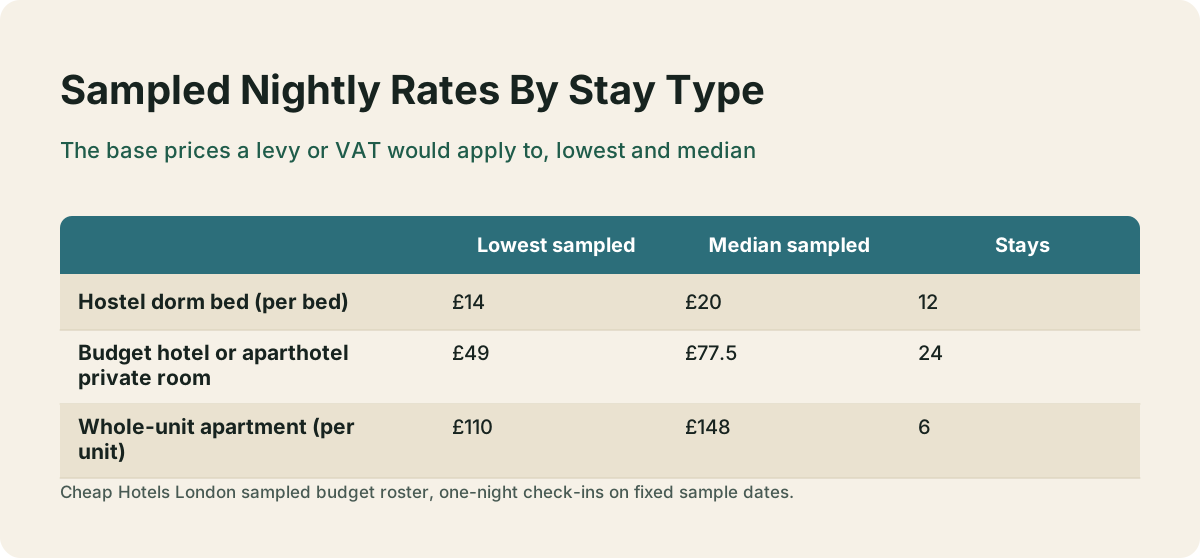
There is a second-order effect worth naming. Because the levy is a percentage of the cost of accommodation, anything that lowers your base price lowers the levy too. The month table shows exactly where the base price falls: dorm medians on the dates sampled run from £20 in November and January to £34 in June, and private room medians from £81 in January to £156 in October. A percentage levy, whenever it arrives, would ride those swings rather than flattening them. Our cheapest months to stay in London guide works through the seasonal pattern in full.
Budget travellers also get a small structural benefit from how the government framed the protection. The release explicitly says the percentage requirement exists to shield families from disproportionate costs on cheaper holidays, which signals that the dorm-and-budget-hotel end of the market was in the drafters' minds, not an afterthought. That is a policy intention, not a price promise, and no rate has been set, but the design principle is confirmed in the official text.
Smart Camden Inn Hostel, the roster's lowest sampled dorm bed at £14 per bed per night and an 8.2 out of 10 score across 3,538 reviews, is the kind of stay the percentage rule was written around. Check availability for your dates if a Camden dorm is your plan.
How To Read Taxes Into The Price On A Listing
Read the listing, not the headline: today a London stay price carries 20 percent VAT inside the accommodation charge and no visitor levy, so the figure you see is the figure you compare. Whether a listed price explicitly includes VAT is shown on the live listing, and no roster row or rule lets anyone assert it for every property, so treat the listing's own wording as the source.
Practical reading, then. When you compare a £49 room against a £65 room against a £14 bed, you are comparing VAT-regime prices against each other, with no hidden city tax waiting at checkout. The only confirmed future change is the levy, which does not exist in law yet. That makes the current booking environment unusually clean for budget arithmetic, and it argues for checking live prices rather than adding speculative tax buffers to your mental math.
| Sampled stay | Area | Type | Lowest sampled rate | Minutes to Charing Cross |
|---|---|---|---|---|
| Dolphin Hotel | Paddington & Bayswater | Budget hotel | From £49 per night | 32 |
| Hotel DC | Stratford | Budget hotel | From £53 per night | 47 |
| Epsilon Hotel | Stratford | Budget hotel | From £65 per night | 44 |
| Smart Camden Inn Hostel | Camden | Hostel | From £14 per bed per night | 26 |
| St Christopher's London Bridge | South Bank, Waterloo & London Bridge | Hostel | From £15 per bed per night | 24 |
All five rows carry identical tax treatment today: 20 percent VAT inside the accommodation charge, no levy, no flat city fee. The spread between the £14 bed and the £65 room is price and product, not tax, and the same will be true of the levy's absolute amounts whenever it arrives, in exact proportion to these prices.
A second reading habit concerns deposits and cancellation, which sit beside tax in the what-you-actually-pay picture and are, unlike VAT, property-specific. Our deposits, cancellation and check-in rules guide collects what the roster prints, and the pattern is that hostels mostly show a free-cancellation flag while budget hotels mostly read Not stated. Not stated means the listing does not say, which is a question for the live listing, not an assumption either way.

Third habit: separate the tax facts from the price facts. The verified tax position for London in one line is, no levy charged yet, percentage-based levy planned, 20 percent VAT in force, 28-day rule for long stays. Everything else in a stay's cost is price, and price is where the roster gives you the real room to save: area medians for private rooms run from £64.5 in Greenwich to £121 around the South Bank, and dorm medians from £16 in Camden to £26 in Victoria and Pimlico, all on the dates sampled.
Will The Levy Make London Stays More Expensive?
Yes, in the plain sense that a new charge added to a price makes the total higher, but no rate exists, so nobody can say by how much, and the confirmed percentage design means the increase on a cheap bed would be proportionally identical to the increase on an expensive room. The government's own framing says the design protects budget stays from disproportionate costs.
Saying "more expensive" without a number is the honest limit of the data. What can be said is structural. A percentage levy scales with the price of the stay, so a traveller holding the roster's cheapest options, the £14 Camden dorm, the £49 Paddington room, the £53 family room at Hotel DC in Stratford, would face the smallest absolute charges of anyone in the market. Compare a flat-fee design, where the £14 bed pays the same nightly toll as the dearest rooms on the roster and the budget share of income is highest.
Timing is the other open question, and it is more knowable. The government says a Bill will be introduced in due course and expects mayors to set out spending plans by early 2028. Those two sentences bracket the realistic window: legislation first, mayoral decision second, implementation third. Stays booked and taken before that sequence completes are levy-free, which is every stay bookable at the time of writing.
There is also a market-pricing question the facts cannot settle: whether hotels would absorb a levy into their rates or pass it through as a separate line. London's market context, with all-hotel average rates around £214.90 in August and year-to-date occupancy flat at 79 percent, suggests a market with pricing power, but that is context, not prediction, and this guide makes no forecast. For a deeper look at why the city's rates sit where they do, see why hotels in London are expensive right now.
What a budget traveller should do with all this is refreshingly little. Book on price, area and travel time as normal, because the tax regime is uniform across every property type you would consider, and no levy applies. If a stay lands after a levy is introduced, expect a proportional charge rather than a flat one, and expect it to be smallest on the cheapest beds. The cheapest beds are, on this roster, London hostels from £14 per bed per night and budget hotels from £49 per room per night, both tax-regime stable today.
Budget travellers comparing London with other capitals can also flip the framing: today London charges no city tax at all, while many rival cities already do. Add in the travel costs that stay bounded regardless, TfL's published daily pay-as-you-go caps run £8.90 for Zones 1 to 2, and a cheap stay in the outer zones can offset its longer travel time against a lower nightly rate. Check TfL for current fares. That is the arithmetic a levy would eventually join, not replace.
Whichever of these three fits your dates, the tax column is identical across them: 20 percent VAT inside the price, no visitor levy, nothing added at the desk. Check availability for your dates and compare the live rates.
Common Questions About London Tax On Hotel Stays
Is there a tourist tax in London?
No. No visitor levy is charged in London yet. The government has said mayors will be given the power to introduce an Overnight Visitor Levy and that a Bill will follow, but nothing is charged today.
How much will the London visitor levy be?
No rate has been announced. The only confirmed design detail is that the levy will be charged as a percentage of the cost of accommodation rather than a flat fee. Any specific percentage you see quoted for London is not in the official government text.
When will the visitor levy start in London?
No start date exists. The government says a Bill will be introduced in due course and expects mayors to set out spending plans by early 2028. The Mayor of London has welcomed the power but no implementation date has been set.
Does the price on a London hotel listing include VAT?
Hotel and holiday accommodation in the UK is charged at the 20 percent standard VAT rate. Whether a specific listed price includes VAT is shown on the live listing itself, so treat the listing's own wording as the source rather than assuming either way.
Do hostels pay the same VAT as hotels?
Yes. Hotels, hostels, guesthouses, B&Bs, aparthotels and short-term holiday lets are all inside the same 20 percent standard-rate regime when supplied as visitor accommodation and the provider is VAT-registered. Only the base price differs.
Is VAT different on a stay longer than 28 days?
Yes. For continuous stays exceeding 28 days in hotels or similar establishments, from the 29th day VAT is charged only on the non-accommodation element, with at least 20 percent of the remaining charge treated as facilities.